









WHAT IS OSM?

OSM is developing an open source Management and Orchestration (MANO) stack aligned with ETSI NFV Information Models. As a community-led project, OSM delivers a production-quality MANO stack that meets operators' requirements for commercial NFV deployments.

OSM Resources:

OSM White Papers


OSM Workshops


OSM Videos


OSM User Guide

ETSI NFV Alignment

OSM is closely aligned with the evolution of ETSI NFV and provides a regularly updated reference implementation of NFV MANO.

Open Source

ETSI OSM uses well-established tools and methods to develop code under the Apache Public License 2.0.

Open Community

Participation to OSM is open to members and non-members of ETSI, as well as individual developers and end users from all across the globe. Check how to join or learn more about OSM.

RECENT NEWS

Sophia Antipolis, 09 September 2025

ETSI Open Source MANO announces Release SEVENTEEN, extending it's capabilities for cloud-native native orchestration.

Sophia Antipolis, 15 January 2025

ETSI Open Source MANO announces Release SEVENTEEN, extending it's capabilities for cloud-native native orchestration.

Sophia Antipolis, 11 October 2024

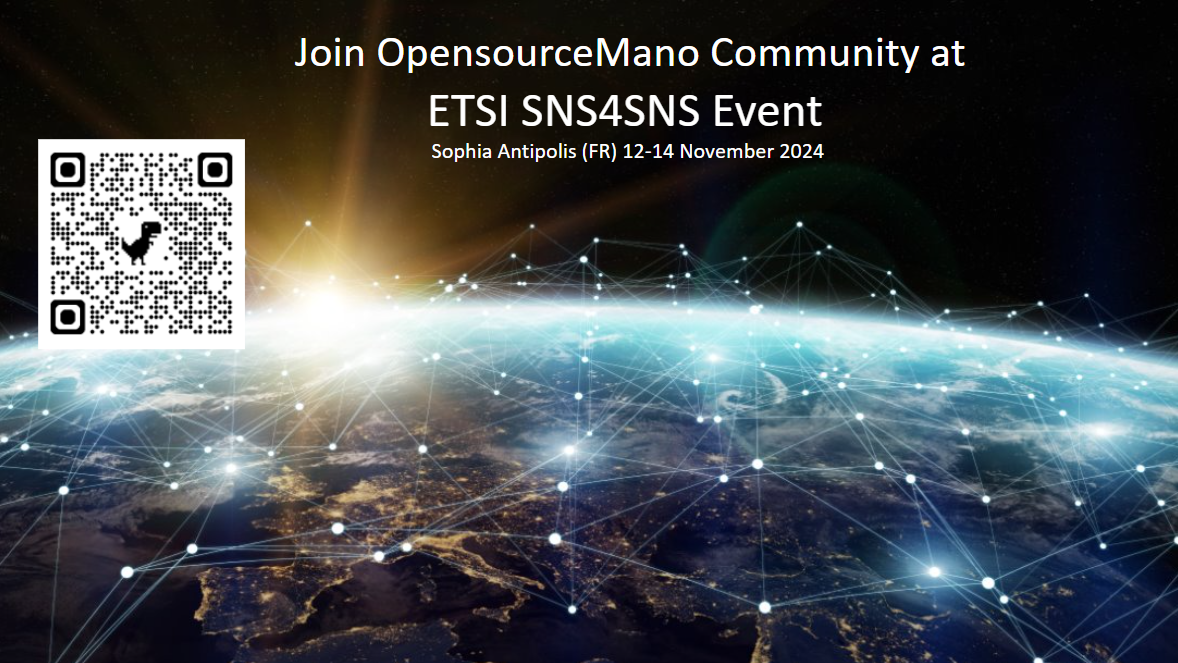
ETSI Open Source MANO will be part of the SNS4SNS event coming this 12-14 November at ETSI headquarters! 

OSM BY THE NUMBERS

0

Lines Of Code

0

Code Commits

0

Participating Organizations

0

Downloads

WHAT PEOPLE ARE SAYING

“Operational effectiveness at the edge is critical to a successful 5G strategy and emerging business models for edge-based compute. OSM Release SIX connects edge and core to provide repeatable and reusable services that span the full telco topology and enable both 5G infrastructure and third-party app ecosystems for the edge in VMs and containers.”

Mark Shuttleworth

CEO of Canonical and founder of Ubuntu

“Management and Orchestration (MANO) is, at the same time, one of the key components and most controversial concepts in network virtualization architecture. Telefónica has long been working from the point of view of innovation in its development. A first result and seed of OSM is OpenMANO, a highly functional framework pioneering the first open source NFV Orchestration and Management stack and, currently, a key component of Telefónica’s NFV Reference Lab. By joining this community, we aim to accelerate the development of MANO while recognizing the value of open-source implementations of NFV and a need to harmonize efforts there.”

Antonio Elizondo

Head of Network Virtualisation Strategy and Technology, Global CTO Unit, Telefónica

“OSM has evolved from an interesting PoC into the most promising architecture for orchestrating VNFs, under the multi-vendor, standardized approach that our Telco customers have been looking for. Increased robustness, as well as exciting features that pave the path towards 5G and the Edge, let us build with confidence the second release of our distribution, WhiteNFV Barcelona, in order to cover the increased demand for operator-led, automated NFV deployments.”

Joris Vleminckx

COO Whitestack

“The ETSI OSG Open Source MANO (OSM) initiative will facilitate the development of open source software for management and orchestration of future networks. Knowledge, capabilities and solutions within this area will be of critical importance to Telenor when virtualizing the network for increased flexibility, faster service delivery, rapid innovation and operational efficiency.”

Patrick Waldemar

Vice President, Telenor Research

“Proprietary management and automation approaches have impeded NFV deployments. Service providers recognize the need for a standardized MANO information model delivered in conjunction with an open source MANO platform to cultivate a robust commercial NFV supplier ecosystem. I’m thrilled with the progress OSM has made to meet these needs and its growing industry acceptance.”

Matt Harper

OSM Founding Member, CTO, RIFT.io

As you may already know, network function virtualization proposes an architecture that allows operators to virtualize network functions in a high-performing, elastic and automated way.  Most of the early use cases are related to mobile networks in a move towards 5G and most implementations aim to have OpenStack as a virtualization infrastructure manager (VIM), complemented with NFV orchestration platforms like the open source projects Open Source MANO (OSM) and Open Networking Automation Platform (ONAP.)

What makes the OSM project unique is how such a diverse ecosystem is pulling together to reach common goals.  Today, the OSM community is not only comprised of global service providers, leading IT/cloud players and VNF providers, but also many 5G research projects that are injecting more life, code and validation of the readiness of this particular NFV MANO implementation.

The latest OSM community gathering was hosted by CTTC in Castelldefels, a beautiful city near Barcelona, Spain. This edition also gave birth to a new event within the scope of the OSM 5th Hackfest 5G day, where 5G research projects have the opportunity to share their work with the larger community.

As Vanessa Little, OSM’s TSC Chair, mentioned during her welcome presentation, these 5G projects, all of them using OSM for implementing NFV MANO orchestration, are very important for its community, driving more innovation and bringing new users and collaboration opportunities.

OSM’s first 5G day accomplished the goals of raising awareness of these projects and fostering collaboration opportunities that are beneficial not only for them and the OSM project, but, as a consequence, for NFV MANO and 5G.

Here’s a look at the projects presented at 5G day:

  • Metro-Haul: aims to design and build an smart optical metro infrastructure able to support traffic originating from heterogeneous 5G access networks, addressing the anticipated capacity increase and its specific characteristics (mobility, low latency, low jitter, etc.) This project gave birth to the WAN Infrastructure Management (WIM) features at OSM release 5.
  • Matilda: designs and implements a holistic 5G end-to-end services operational framework, tackling the life cycle of design, development and orchestration of 5G-ready applications and network services over virtual and physical infrastructure, following a unified programmability model and a set of control abstractions.

  • 5GTango: aims to incorporate flexible programmability of 5G networks by collaborating with different open-source initiatives to accelerate the NFV uptake in industry.  In the context of OSM, this project has contributed with a VIM emulator, advanced NFV packages formats, network slicing and many automation efforts.

  • 5GCity: designs, develops, deploys and demonstrates, in operational conditions, a distributed cloud and radio platform for municipalities and infrastructure owners acting as 5G neutral hosts.
  • 5G-Media: A project looking to consolidate and/or build an orchestration and DevOps platform for network media services and applications running on 5G networks.


  • 5G-Transformer: a project that seeks to bring network slicing into mobile transport networks by provisioning and managing slices tailored to the needs of verticals, enabling them to meet their specific service requirements.

As you can see, these projects are making important progress in demonstrating real-life use cases of 5G over NFV, accelerating the development of associated platforms and technologies at the same time, thus providing a clear indicator that we are moving forward as an industry towards successful 5G implementations.

For more information about OSM’s growing community, including OSM distributions, compatible VIMs, tested VNFs, training providers and a extended list of research projects, take a look at the OSM ecosystem.