










One point the industry as a whole can agree on is that an agile, flexible, and intelligent network is a must-have requirement for 5G, irrespective of use case. Key to this is enabling network-wide virtualization of both the infrastructure and the essential functions that promise to accelerate the development and deployment of new applications and services. At the most recent Mobile World Congress, Netrounds, RIFT.io, Telenor, Intel, and Arctos Labs unveiled a highly relevant proof of this concept with “DevOps in Service Chains and 5G Network Slices”.
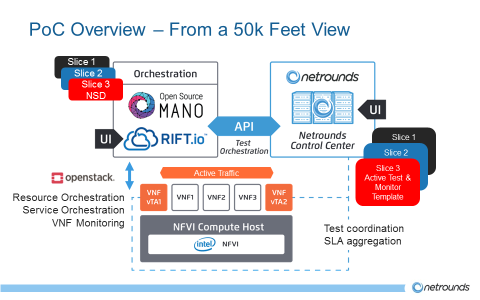
This week, the ETSI Open Source MANO (OSM) Leadership Group is pleased to announce that this proof of concept has been officially accepted as ETSI OSM PoC #1. The DevOps in Service Chains and 5G Network Slices PoC is the first of what will be many such PoCs within the OSM project. Here is a birds-eye view of the PoC courtesy of a Netrounds presentation:
ETSI NFV PoCs “help to build industry awareness and confidence in NFV as a viable technology and help to develop a diverse, open, NFV ecosystem.” In the same way, ETSI OSM PoCs build awareness and confidence in OSM as a production quality MANO solution, as well as creating momentum and collaboration amongst VNF vendors, MANO providers and integrators, and NFVI/VIM vendors. ETSI OSM PoCs also provide comprehensive feedback to the TSC and OSM community from experience with OSM in real-world use cases and multi-vendor environments.
ETSI NFV PoCs “help to build industry awareness and confidence in NFV as a viable technology and help to develop a diverse, open, NFV ecosystem.” In the same way, ETSI OSM PoCs build awareness and confidence in OSM as a production quality MANO solution, as well as creating momentum and collaboration amongst VNF vendors, MANO providers and integrators, and NFVI/VIM vendors. ETSI OSM PoCs also provide comprehensive feedback to the TSC and OSM community from experience with OSM in real-world use cases and multi-vendor environments.
ETSI OSM PoC #1 highlights three important advantages and capabilities made possible through cloud-enabled network virtualization, specifically:
DevOps for Telecom: By integrating the development and operations functions under one cohesive organizational structure, DevOps can compress the time required to roll out new assured applications and services, which can mean more revenue streams for operators. In other words, adopting DevOps can fully leverage the agility and flexibility benefits of network virtualization.
Simplified Service Chaining: Network virtualization, via SDN and NFV, can streamline the process for chaining various network services using a single network connection through automation and defined policies.
Network Slicing: This is the ability for operators to split a physical network into any number of virtual networks, a concept similar to server virtualization and its role in creating virtual machines. Network slicing will be a critical capability for 5G networks in order to accommodate the capacity and reliability requirements for supporting the very large number of connected devices.
The PoC integrates all three elements as part of an assured, end-to-end service fulfilment/assurance lifecycle that directly addresses the reality of complexities and frequent changes that mobile and even wireline operators must contend with today in their networks. The goal of the PoC is to demonstrate that operators can ensure that the services they are delivering meet both their contracted SLA requirements and demanding customer quality expectations. Ensuring optimal customer experience is arguably the top priority for any mobile operator, among the many challenges they face in fully rolling out 5G.
As we are kicking off the ETSI OSM PoC program, I am excited about the new opportunities that this initiative brings to tangibly demonstrate the value of OSM to advance the use cases and service deployment scenarios that are critical to operators worldwide.