









WHAT IS OSM?

OSM is developing an open source Management and Orchestration (MANO) stack aligned with ETSI NFV Information Models. As a community-led project, OSM delivers a production-quality MANO stack that meets operators' requirements for commercial NFV deployments.

OSM Resources:

OSM White Papers


OSM Workshops


OSM Videos


OSM User Guide

ETSI NFV Alignment

OSM is closely aligned with the evolution of ETSI NFV and provides a regularly updated reference implementation of NFV MANO.

Open Source

ETSI OSM uses well-established tools and methods to develop code under the Apache Public License 2.0.

Open Community

Participation to OSM is open to members and non-members of ETSI, as well as individual developers and end users from all across the globe. Check how to join or learn more about OSM.

RECENT NEWS

Sophia Antipolis, 02 February 2026

ETSI Open Source MANO announces Release NINETEEN, extending it's capabilities for cloud-native native orchestration.

Sophia Antipolis, 09 September 2025

ETSI Open Source MANO announces Release SEVENTEEN, extending it's capabilities for cloud-native native orchestration.

Sophia Antipolis, 15 January 2025

ETSI Open Source MANO announces Release SEVENTEEN, extending it's capabilities for cloud-native native orchestration.

OSM BY THE NUMBERS

0

Lines Of Code

0

Code Commits

0

Participating Organizations

0

Downloads

WHAT PEOPLE ARE SAYING

“Operational effectiveness at the edge is critical to a successful 5G strategy and emerging business models for edge-based compute. OSM Release SIX connects edge and core to provide repeatable and reusable services that span the full telco topology and enable both 5G infrastructure and third-party app ecosystems for the edge in VMs and containers.”

Mark Shuttleworth

CEO of Canonical and founder of Ubuntu

“Management and Orchestration (MANO) is, at the same time, one of the key components and most controversial concepts in network virtualization architecture. Telefónica has long been working from the point of view of innovation in its development. A first result and seed of OSM is OpenMANO, a highly functional framework pioneering the first open source NFV Orchestration and Management stack and, currently, a key component of Telefónica’s NFV Reference Lab. By joining this community, we aim to accelerate the development of MANO while recognizing the value of open-source implementations of NFV and a need to harmonize efforts there.”

Antonio Elizondo

Head of Network Virtualisation Strategy and Technology, Global CTO Unit, Telefónica

“OSM has evolved from an interesting PoC into the most promising architecture for orchestrating VNFs, under the multi-vendor, standardized approach that our Telco customers have been looking for. Increased robustness, as well as exciting features that pave the path towards 5G and the Edge, let us build with confidence the second release of our distribution, WhiteNFV Barcelona, in order to cover the increased demand for operator-led, automated NFV deployments.”

Joris Vleminckx

COO Whitestack

“The ETSI OSG Open Source MANO (OSM) initiative will facilitate the development of open source software for management and orchestration of future networks. Knowledge, capabilities and solutions within this area will be of critical importance to Telenor when virtualizing the network for increased flexibility, faster service delivery, rapid innovation and operational efficiency.”

Patrick Waldemar

Vice President, Telenor Research

“Proprietary management and automation approaches have impeded NFV deployments. Service providers recognize the need for a standardized MANO information model delivered in conjunction with an open source MANO platform to cultivate a robust commercial NFV supplier ecosystem. I’m thrilled with the progress OSM has made to meet these needs and its growing industry acceptance.”

Matt Harper

OSM Founding Member, CTO, RIFT.io

Year 1: OSM races out of the starting gates to shape global MANO ecosystem

January 2017

Written by Chris Buerger, Intel, Chair OSM Marcom Task Force


Speed matters. In software development, no matter whether it is proprietary or open source, early success is often defined in the same way as an Olympic 100-meter dash. The first few steps out of the starting block are critical in quickly getting to the 100m point. The race then changes once this has been accomplished – the straight line race track starts to curve and a group of runners settles in to run the distance and find success at the finish line. 

To me, the first year of OSM bears a number of similarities to a 100-meter race, and as the year 2017 has just started, I am taking some time to reflect on what we have jointly accomplished since the inception of the OSM community and outline a number of personal thoughts on key themes for this new year.

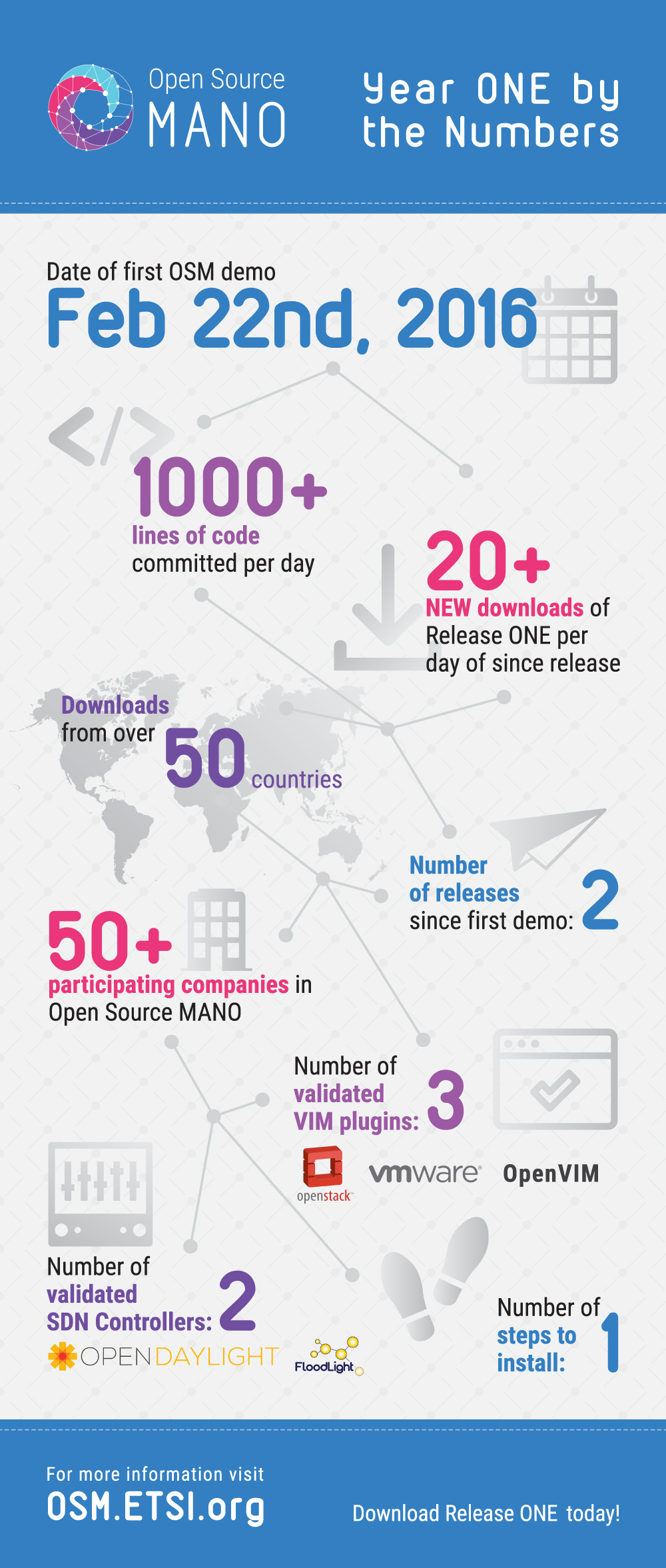
Not to wax nostalgic, but looking back at 2016 does showcase a number of accomplishments that would be the envy of the majority of open source communities. From the first public OSM demonstration at the end of February at MWC 2016, to creating two OSM releases that have been downloaded more than 2000 times from 50+ countries, to capturing the interest of 55 organizations that have joined OSM, we have much to be proud of. On the technical side, the creation of a well-functioning, one-step installable, multi-VIM, multi-SDN controller OSM Release ONE that incorporates information models commonly agreed upon by a group of operators and solution vendors stands out to me. On the community engagement side, the OSM workshop at SDN World Congress in The Hague, the launch of the new website, quarterly newsletters, the OSM Twitter channel and, personally most important, the contributions of an awesome group of marketing professionals to create awareness and excitement for OSM top my list.

Year 2 will be different. Speed still matters, but it will be accompanied by well-measured collaboration activities to take the OSM software stack through the standard lab/field/production deployment cycle with service providers engaging in MANO. Interoperability, stability, security and the size and maturity of the commercial support ecosystem for OSM will become key themes on the road to production deployments. New use cases and network service scenarios from the broader community will tie the code base to its economic value. I expect that OSM’s guiding principle of modularity for any software component will provide additional choice and capabilities. 

In addition, as a result of the success of broadly observed initiatives such as Telefonica’s UNICA program, a set of existing and new community members will choose to actively invest time and contribute engineering expertise and code as purchase points for OSM proliferate across the globe. ETSI’s groups for NFV and MANO will receive an increasing amount of input based on the pragmatic results of the work within OSM.

So speed and timing will still matter as OSM turns its sights from a 100-meter dash to a 10k race in 2017. I believe that as with other successful software development initiatives, collaborative and reliable execution and a singular focus on unlocking OSM’s economic value for the entire community over the next 5-10 years will set us apart. OSM’s accomplishment in getting out of the starting block with speed and clear direction is the best indicator for continued success in 2017 and beyond.